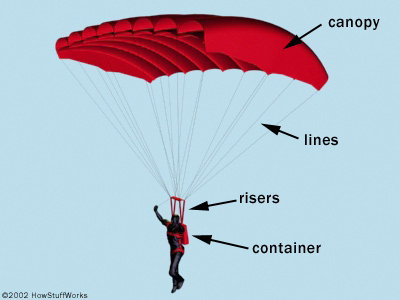
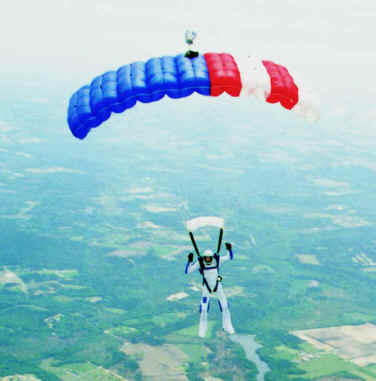
Parachutes Domina Jalber is the inventor most credited with refining the concept behind a modern, multi-celled, rectangular, gliding parafoil who came up with his parafoil design in 1966. Although other inventors experimented with gliding parachute designs before and after Jalbert, his parafoil was essentially the key to modern "ram air" parachute design, and the beginning of a new era in sport parachuting. When BASE jumping was still a new thing many of the people who tried it died or were injured as they were not using the right sort of equipment for example the jumpers that where injured on the El Capitan in 1966 were using older round parachutes, which contributed to their problems. Modern day BASE jumping uses the newest types of ram-air parachutes. These types of chutes are rectangular to give the jumper greater control over direction and speed once it has been deployed. The fabric used in ram-air parachutes today is a special type of "rip-stop" nylon that uses "zero porosity" ("ZP") technology. The special "rip stop" weave pattern greatly counters the tendency for a rip to enlarge. Additionally, the nylon is specially treated to prevent the passage of air through its skin (thus "zero porosity"). This "ZP" treatment significantly enhances the canopy's flight characteristics, resulting in longer fabric life, better glide ratio and extremely soft landings. All canopies today use "rip-stop" technology, most also use "ZP" technology. Many think that BASE jumping and skydiving is rather similar in lots of different aspects including the equipment but there are some key differences between skydiving gear and BASE jumping gear. BASE jumpers need special kinds of equipment and techniques so a parachute made especially for BASE jumping costs between $1,200 and $1,500. When BASE jumping you have to overcome two major obstacles which are low altitude and the proximity of the BASE object. Skydivers typically open their chutes at around 2,000 feet. This gives them time to deploy the parachutes gradually (reducing line tangles and a sudden jerk on the diver) using a device called a slider. It also gives them a little breathing room. If there is a problem with the main parachute, they can still deploy their back-up chute. But many BASE jumps start out well below 2,000 feet. While jump sites such as El Capitan and Angel Falls in Venezuela are around 3,000 feet, they are the exception. Skyscrapers and antenna towers are usually 1,000 to 1,500 feet tall. As a result, jumpers have to deploy their parachutes quickly.
|
   |

