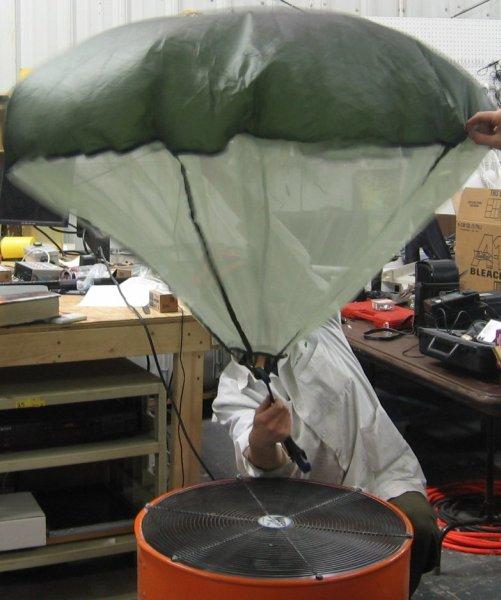
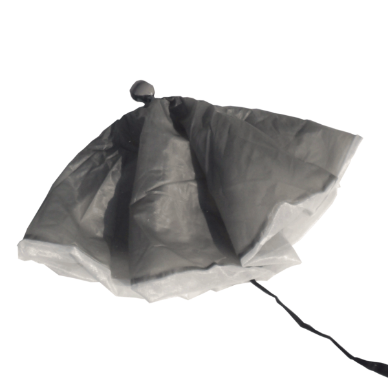
Pilot Chute A pilot chute is a small auxiliary parachute used to deploy the main or reserve parachute. The pilot chute is connected to the deployment bag containing the parachute by a bridle. On modern skydiving or BASE jumping rigs three types of pilot chutes can be found.
Spring loaded The spring loaded pilot chute is used in conjunction with a ripcord. When the user pulls the ripcord, the container opens, allowing the pilot chute compressed inside to spring out. Spring loaded pilot chutes are mainly used to deploy reserve parachutes. They are often also used to deploy the main parachute on skydiving students' parachute equipment
Pull-out The pull-out and throw-out pilot chutes are identical in construction; the difference is in their connection to the handle and the bridle, and in the way they are packed. With the pull-out system, the pilot chute is packed inside the container. The activation handle is attached to a lanyard, which in turn is attached to the closing pin. The lanyard is also attached to the bridle. When the user pulls the handle, the closing pin is pulled, opening the container. Continuing the pull, the user pulls the pilot chute out of the container and into the airstream, at which point the pilot chute inflates and pulls the main parachute out of the container.
Throw-out The throw-out pilot chute is the most popular type in use today. The pilot chute is packed in a pouch at the bottom of the container (often called BOC for short). The handle is attached to the apex of the pilot chute. When the user grabs the handle and throws the pilot chute into the airstream, the bridle extends, pulling the closing pin and opening the container, as the pilot chute continues in the airstream it extracts the deployment bag containing the main parachute from the container. The throw-out pilot chute was invented by Bill Booth.
BASE Jumper BASE jumpers use a larger pilot chute. Larger pilot chutes catch more air, create more drag and open main chutes more quickly. They are also helpful because low altitude jumps force jumpers to open their chutes at a lower velocity -- they haven't been falling long enough to achieve a freefalling human's terminal velocity (around 120 mph). Lower speeds mean reduced air pressure in the chute, so a larger chute is more effective. Because many BASE jumps are so low that only about five seconds of freefall are possible before impact, some BASE jumpers don't bother packing back-up chutes. If the main chute fails to deploy, or deploys incorrectly, there isn't the time to cut away a malfunctioning chute and deploy the back-up. Instead of a ripcord, BASE jumpers release their pilot chute manually. For higher jumps, the pilot chute is stowed in an easily accessible pocket or flap, and the jumper pulls it free to release it at the right moment. This leaves both hands free during the brief freefall. If the jump is shorter, the jumper usually just holds the pilot chute in his or her hand.
|
   |

