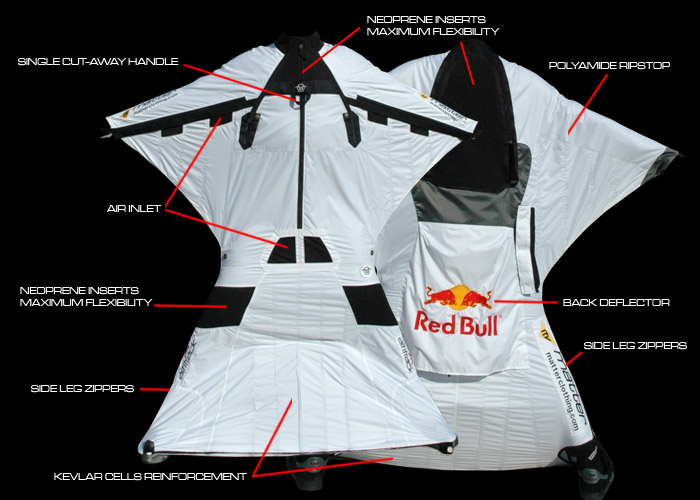
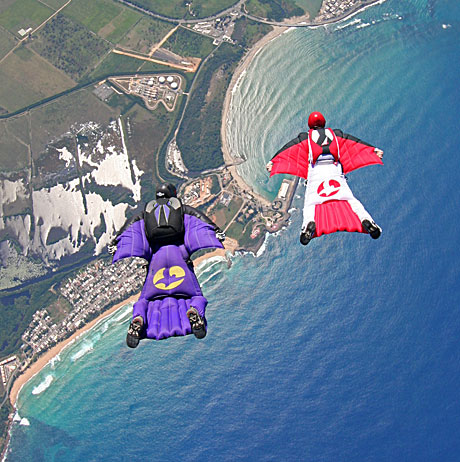
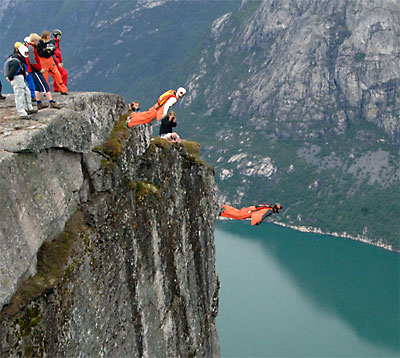
Wingsuits Wings were first used in the 1930s as an attempt to increase horizontal movement. These early wingsuits were made of materials such as canvas, wood, silk, steel, and even whale bone. They were not very reliable. According to wingsuit lore, between 1930 and 1961, 72 of the 75 original birdmen died testing their wingsuits. Some "birdmen", notably Clem Sohn and Leo Valentin, claimed to have glided for miles. In early 1998, Tom Begic, a BASE jumper from Australia, built and flew his own wingsuit based on a photograph of Patrick de Gayardon and his ideas. The suit was developed to assist Begic in capturing freefall footage of BASE jumpers while jumping the high cliffs of Europe. The benefits of the suit included: reduced freefall descent rates, increased freefall times, greater maneuverability around other jumpers and objects whilst in freefall, the potential to jump off sites around the world that were not possible without wingsuits, and the ability to accelerate away from under hung walls much more quickly. In early 1999, Begic stopped development of his suit when he met Robert Pečnik and learned of plans for the creation of a wingsuit manufacturing company. A wingsuit flier manipulates the shape of his body to create the desired amount of lift and drag although most wingsuits have a 2 to 1 ratio. This means that for every foot they drop, they go two feet forward. With body shape manipulation and by choosing the design characteristics of the wingsuit, a flier can alter both his forward speed and fall rate. A pilot can choose to manipulate his fall rate towards Earth with the goal of achieving the slowest vertical speed in order to prolong time in freefall, or the pilot can try to maximize the horizontal glide distance across the Earth. The pilot manipulates these flight characteristics by changing the shape of his torso, arching or bending at the shoulders, hips, and knees, and by changing the angle of attack in which the wingsuit flies in the relative wind, and by the amount of tension applied to the fabric wings of the suit. The absence of vertical stabilizing surface results in little damping around the yaw axis, so poor flying technique can result in a spin that requires active effort on the part of the skydiver to stop. Wingsuit fliers can measure their performance relative to their goals with the use of freefall computers that will indicate the amount of time they were in flight, the altitude they deployed their parachute, and the altitude they entered freefall. The fall rate speed can be calculated from this data and compared to previous flights. GPS receivers can also be used to plot and record the flight path of the suit, and when analyzed can indicate the amount of distance flown during the flight. BASE jumpers can use landmarks on exit points, along with recorded video of their flight by ground crews, to determine their performance relative to previous flights and the flights of other BASE jumpers at the same site. The suit also enables the wearer to travel longer distances horizontally; glide ratios of 2.5:1 are commonplace. The tri-wing Wingsuit has three individual ram-air wings attached under the arms and between the legs. The mono-wing wing suit design incorporates the whole suit into one large wing. Watch this for an awesome example: |
  |